Youth, Peace and Security and SSG/R
DCAF actively advances the Youth, Peace and Security (YPS) agenda by integrating youth perspectives into security sector governance and reform (SSG/R) processes. To that end, we leverage our research to bridge the gap between high-level policy commitments, such as UN Security Council Resolution 2250, and the operational realities faced by security institutions.
DCAF is developing practical tools based on empirical evidence to respond to the specific needs of SSG/R and YPS policymakers and practitioners engaging with youth to foster inclusive security sector governance.
Workstreams/Projects
DCAF believes that sustainable peace is impossible without the meaningful inclusion of young people in the structures that govern their security. Our work sits at the critical intersection of the Youth, Peace and Security (YPS) agenda and Security Sector Governance and Reform (SSG/R), aiming to transform policy commitments into tangible operational realities.
We move beyond theory to provide security institutions, governments, and civil society with the concrete frameworks needed to recognize youth not merely as beneficiaries, but as essential partners in building safe and resilient communities.
To support practitioners in this effort, we have developed a suite of resources designed to bridge the gap between high-level policy and practice. Explore our latest publications to discover how integrated approaches can foster trust, enhance accountability, and drive inclusive reform.
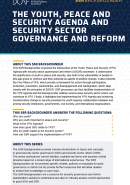
Backgrounder “The Youth, Peace and Security Agenda and Security Sector Governance and Reform”
This SSR Backgrounder discusses who constitutes youth within the YPS framework and underscores the significance of youth in peace and security, due both to the vulnerability of people in this age group to violence and their potential as agents of positive change.
It also presents the Five Pillars of YPS, which provide a framework for action through participation, protection, prevention, partnerships, and disengagement and reintegration.
These pillars align closely with the principles of SSG/R, especially participation, effectiveness, accountability, responsiveness, rule of law, and gender equality. SSR processes can thus facilitate implementation of the YPS Agenda by enhancing youth participation, improving protection and prevention efforts, fostering partnerships, and integrating disengagement and reintegration initiatives.
To that end, this Backgrounder outlines various ways security sector actors can contribute to YPS, including through internal reforms, the commitment of leadership, oversight, engagement with civil society, educational initiatives, and international support.
Moreover, it highlights that effectively implementing the YPS Agenda and achieving transformative change in security provision for youth requires collaboration between and among security institutions, governments, civil society, and international organizations.
Bridging the Gap: Leveraging synergies between the Youth, Peace and Security Agenda and Security Sector Governance and Reform (SSG/R)
This short thematic paper was submitted as input for the Second Independent Progress Study on Youth, Peace and Security.
A decade after its adoption, the Youth, Peace and Security (YPS) agenda faces a critical implementation gap: while policy commitments to youth participation and protection have expanded, these are not consistently reflected in how security institutions operate in practice. This paper argues that bridging this gap requires leveraging synergies with Security Sector Governance and Reform (SSG/R). SSG/R offers practical entry points to transform security institutions from potential sources of youth grievance into partners for peace. By leveraging YPS National Action Plans as strategic bridges, youth participation in security sector governance can be promoted and enhance prevention and responsiveness. Strengthening the integration of YPS and SSG/R can enhance prevention, accountability, and trust, and support more inclusive and sustainable peacebuilding outcomes.
Guidance Notes (forthcoming)
Publications
Contacts
Taynja Abdel Baghy, Senior Project Officer, Policy Engagement (t.abdelbaghy@dcaf.ch)