Why International Humanitarian Law is important in time of war?

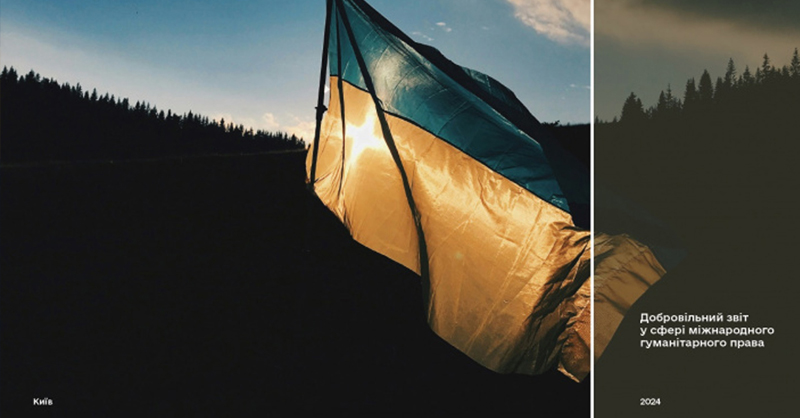
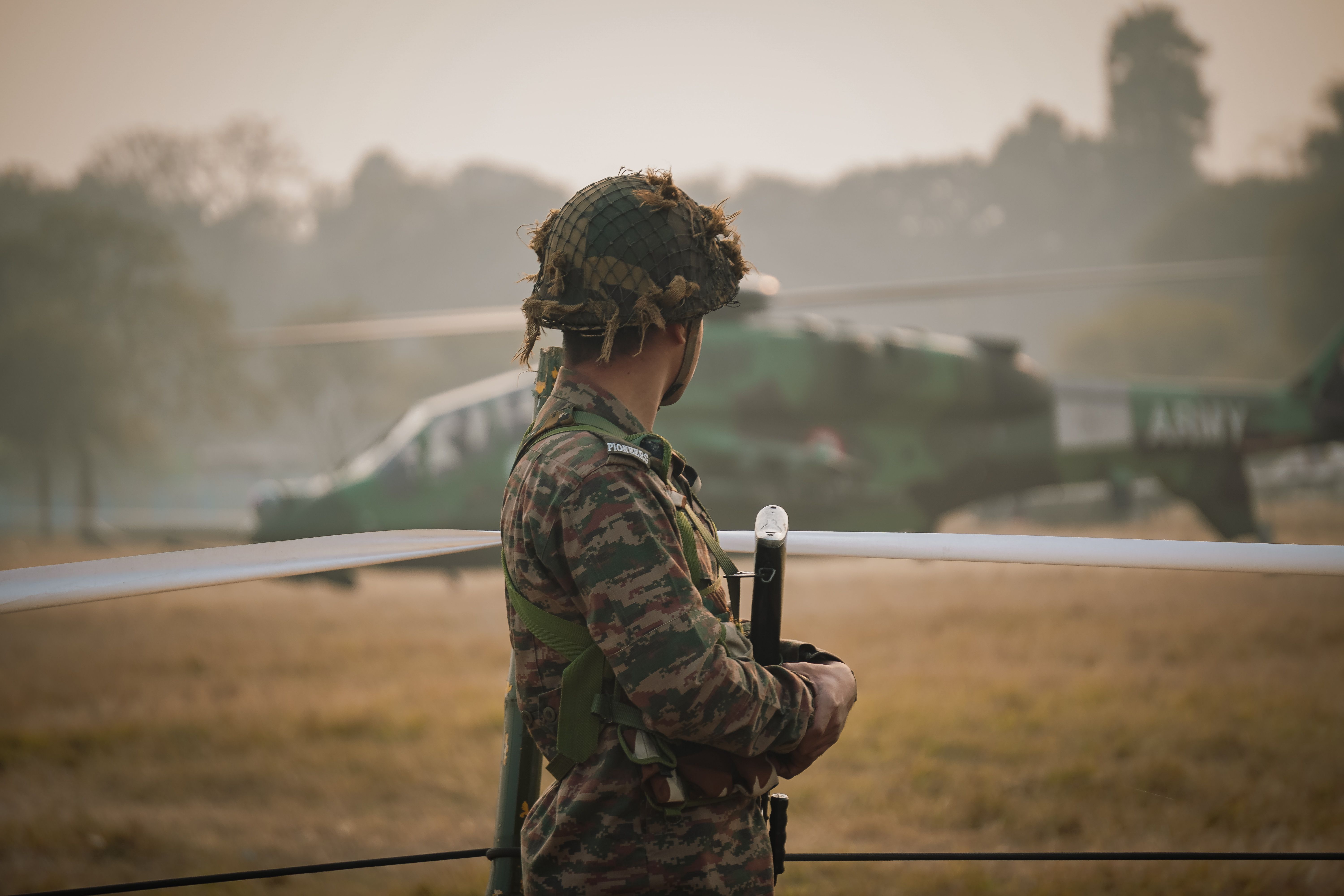
pexels-Soumalya Halder

Why International Humanitarian Law is important in time of war?

  • IHL
  • Ukraine

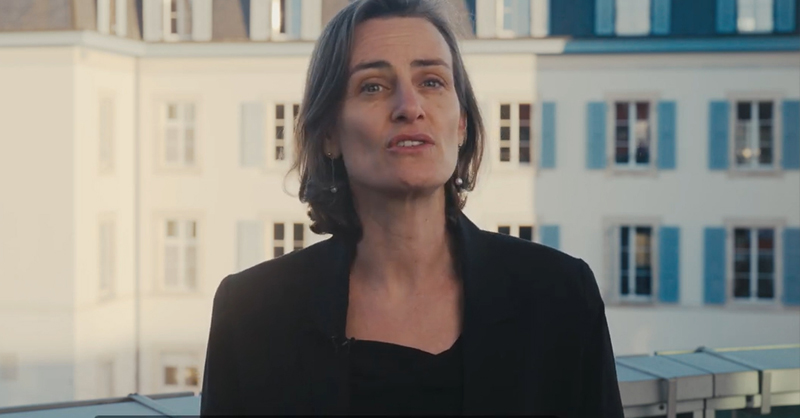
Guest(s): Inna Zavorotko, Colonel of Justice of the Armed Forces of Ukraine, Head of the International Law Division of the Legal Support Department of the Ministry of Defence

In this episode, we speak to Inna Zavorotko, Colonel of Justice of the Armed Forces of Ukraine and Head of the International Law Division of the Legal Support Department of the Ministry of Defence.

She explains how the Ministry of Defence helps the Armed Forces comply with International Humanitarian Law (IHL), and discusses the work carried out on the Ukraine Voluntary Report on the implementation of IHL.

Key takeaways
  • IHL remains essential in modern warfare, and its core principles can still be applied to emerging technologies such as drones, AI, and cyber warfare.
  • The proactive role of each state in the implementation and compliance with IHL is very important, particularly in the current climate where the global order and international law are under threat.
  • Soft law and instruments can help states develop a shared understanding of how IHL applies in specific situations.
Download Transcript PDF
Maritie Gaidon
Welcome to Shaping Security, the podcast where we put security governance at the heart of the conversation and update you on today's security challenges. In today's episode, we're going to talk about why international humanitarian law is so important, particularly in times of war. To tackle this topic, I'm joined by Inna Zavorotko, Colonel of Justice of the Armed Forces of Ukraine.
Hi, thank you very much for being here. Hi, it's a pleasure. Thanks for the invitation.
Your current role involves overseeing the implementation, enforcement and dissemination of IHL within Ukraine's Armed Forces. As the head of the International Law Division of the Legal Support Department of the Ministry of Defence, could you explain the role of the Ministry of Defence in helping the Armed Forces comply with IHL?
Inna Zavorotko
That's a really great question. As you mentioned, I'm the head of the International Law Section and we are responsible for together with my team responsible for IHL implementation, compliance with and dissemination. And here we work closely with the Armed Forces of Ukraine as one of institutions which is subordinated to the Ministry of Defence.
And we work a lot on the policy level. We work a lot on drafting different documents, including legislation to ensure that Ukraine as a state implements IHL provisions in the most efficient way in our legislation. But also we work a lot with doctrine and with more soft tools such as recommendations, guidelines, advisors and so on and so forth.
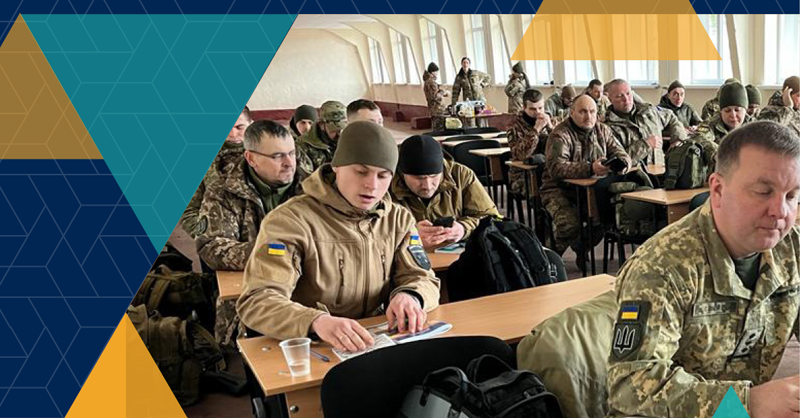
We also cooperate a lot on IHL dissemination to the whole Armed Forces. Again, for very different categories, legal advisors, obviously commanders, civil military cooperation officers, chaplains and regular soldiers as well. Within that, we work a lot with international partners, both with governments and international organisations to ensure that we use the most efficient expertise which is available across the globe to provide trainings to our Armed Forces.
We believe a lot that the IHL training should be incorporated into general training and education system. So IHL should be part of the general training system. And for now, we have IHL module which is incorporated into every course where it is obviously relevant, starting with basic military training, which is recruit training and ending with a strategic level trainings.
So as you can see, there is a lot of ways how Ministry of Defence supports Armed Forces of Ukraine in IHL dissemination, compliance with and implementation. And for us, it's as Ukraine, as a defence entity, it is super important that our own forces continue to comply IHL, despite Russian forces do not care about international law more broadly, but IHL specifically as well.
Maritie Gaidon
You talk about different ways, but it also shows a different range of actors. So it's impressive.
Inna Zavorotko
Yeah, that's true. And for us, it's very important to operate with all actors, which we have on the national level, but on international level as well. And we can openly say that now Ukrainian expertise contributes more and more into the training courses of our foreign partners also.
So very often we not only engage with partners in bringing their expertise to our courses, but also sharing our expertise, especially in the areas of IHL and cyber warfare, IHL and AI, IHL and drones. So new technologies and new warfare, which is going on, unfortunately, between Russian Federation and Ukraine, brought a very unique experience on how we comply with IHL during the modern warfare. And the war between Russian Federation and Ukraine is globally called the War of Drones.
So with this specific issue, we have a lot of expertise, which clearly demonstrates that when state has a good face to follow IHL, it can follow IHL even by using new technologies. And drones can be really very good friends of IHL, because we use drones not only as means of warfare, but also for humanitarian purposes. For example, we capture enemy combatants with drones, we deliver humanitarian aid with drones, we deliver medical kits with drones, we evacuate both civilians and wounded and sick combatants, Ukrainian and Russians, by using land drones, and so on and so forth.
So there are plenty of ways how you can actually use new technologies to ensure that your own forces comply with IHL.
Maritie Gaidon
What you're talking about is leading to a question that I have for later, but I will directly ask you now. So all these emerging technologies are creating new challenges. You have given just right now a few examples of how it is on the field after this, but how do you see it reflected in IHL in general?
Inna Zavorotko
Yeah, so that's a really very good question, because as most probably all of us know that the core IHL conventions were shaped after the Second World War. So for now, we can say that they are slightly outdated, and there are global talks on do we need to amend IHL conventions or not. I don't know, that's an open question.
I really doubt that globally we are now in the position to reach an agreement on another IHL convention related to new technologies. However, principles of IHL remain the same. So if there is a strong political will to follow international laws, then you definitely can do that.
Yeah, we can say that, for example, the Geneva Convention mentions horses as something that belongs to POWs. And obviously, we do not use horses in Russian-Ukrainian war, despite the few facts from the Russian Federation side. However, we do not use horses, but we use drones.
And the general principles of IHL which apply will remain the same, right? So even if we all agree that the core conventions on IHL are slightly outdated, principles remain the same. And principles allow us to follow the spirit of IHL and to shape our activities in line with this.
Yes, there is no separate convention on, for example, AI and IHL or autonomous weapon and IHL or cyber and IHL, right? So these are new things which are broadly used in contemporary armed conflicts, including Russian Federation-Ukraine armed conflict. However, again, it does not mean that there is a gap, right?
But it does not mean that there is no rules which we can use to fulfil that gap. And in such circumstances, the role of state becomes higher. It means that if there is no clear provision on the international level how to act in different cases, it means that there should be national legislation and national position on how own soldiers of the state need to act.
So I would say that even if we all agree that there is a gap in the IHL related to new technologies, we still have principles which remain the same. And we still have national legislation which can and should be drafted by different states to provide clear instructions and clear guidelines to their own forces.
Maritie Gaidon
Okay, and when you say the role of states become higher with national legislation, it also means compliance. So what implication does this have in terms of compliance, maybe now or for the future?
Inna Zavorotko
Yeah, that's a very important question because, you know, unfortunately, some states across the globe try to play with international law. And during recent years, we see that the number of these states is increasing, unfortunately. However, a state is the main actor in international law, right?
So the political will of state is the only source of power when the convention can be agreed and signed, but also when the convention can be implemented on the domestic level, on the national level, in different countries. That's why the role of state is very important, especially now when we do not have the clear consensus across the globe to have one more convention, for example, or other international law instrument which can regulate these new tech things and IHL, the role of the national authorities and state as such becomes higher and higher. And again, one thing is to shape your national policy and to shape your national legislation.
And the other thing is also is to disseminate this position across the globe and to share it with other countries and to build coalitions. And when we build coalitions, we can talk about firstly, soft instruments or soft law, which can be used to shape the common understanding of how IHL shall apply to a particular situation. And these soft instruments are really very powerful as well.
And I would say that in the circumstances when we are far away from the position to agree on one more convention, internationally legally binding convention, then the power of soft law, of soft instruments become more and more important. That's why the proactive role of each and every state in IHL implementation and compliance is very important, specifically in our days when the global order is challenged and international law as such is challenged as well.
Maritie Gaidon
Okay, the next question will be about what is called voluntary report. So for our listeners, it's a detailed report drafted by state tracking how international legal obligations have been incorporated into its national laws, policies and practise. This is not mandatory.
This is not a binding document, but it's an assessment that identifies areas for action and demonstrate transparency and commitment. So Ukraine is the first country to have produced a voluntary report on implementation of IHL in times of war and to have made it public. How has the process revealed any gaps in the existing framework?
Inna Zavorotko
Yeah, thanks a lot for that question. And again, we were talking about soft instruments and how they can be used in modern state. And I would say that the voluntary reports is actually one of such instruments.
That's the document how or in which state reports or presents to the rest of the globe and to everyone who is interested, how it implemented IHL on the domestic level. And you are totally right that Ukraine is the first state who issued this report during the war. And I would say an active phase of war with the Russian Federation.
There is one more peculiarity is that this report was issued on behalf of the Ministry of Defence, not on behalf of Ukraine as a state. And it differs our report from other reports in the voluntary report family. Again, for us, it was super important in 2024 to issue this report.
And it was presented on the 34th conference also with other reports. It was very important for us to catch the moment and to demonstrate to our partners how IHL is followed by Ukrainian side. And again, this report is very unique also because of other reasons.
The first one is that it presents not only legislative acts and norms, how we implemented IHL on the domestic level, but also there are many practical cases and practical tools, which Ukraine developed to implement and disseminate IHL. So there are many, many of them. There are practical cases like video recorded by drones on how we conduct combat activities for different means and methods.
There are cases of perfidy, for example, recorded, which were committed by Russian Federation. There are cases of humanitarian use of drones and how it is done on the ground. There are cases on using different means of warfare, like cluster munitions, for example, and so on and so forth.
So it's really super, super practical tool, which can be used for different purposes. And one more peculiarity is that we provide Ukrainian answers on very practical questions, which we face. So you will find examples of soldier cards there, for example, on IHL dissemination, but also on preventing and combating conflict-related sexual violence.
You will find cases and practical examples on what is the role of Ukrainian armed forces and more broadly defence forces in identification and investigation of war crimes committed by Russian side. So that's not clearly the task of the armed forces, but the role of the armed forces is very high as well. You will find a lot of cases also on how we use new tech, not only to conduct combat operations, but also to plan combat operation.
How we use new tech and different designed in Ukraine systems to share information, to monitor the battlefield, to identify targets and so on and so forth. So it really provides a very comprehensive picture of how IHL is implemented and disseminated in Ukraine. And more broadly, you will find also practical packages of IHL modules, which we disseminate to our soldiers, sergeants, legal advisors, and commanders as well.
So I always say that voluntary report can be used for many purposes. For example, if you're an instructor on the military base of one of the states across the globe, you can use this voluntary report to see how you can incorporate recent battlefield examples on IHL compliance into your own materials. That's the one thing, a very practical one, right?
The second is if you're academia and you would like to make your research not only theoretical, but also practical. And then if you want to deep dive in cases, you can find those cases in the voluntary report. It can be a really very good starting base to identify the patterns and to identify the cases in which you can deep dive as a researcher later on.
And of course, if you represent the government on different levels, I would say you should read the report and you should see how and which new instruments can be used to ensure that IHL is implemented and disseminated on the sufficient level. And again, Ukrainian experience is very unique because we have, unfortunately, a very unique experience of warfare with the Russian Federation since 2014. So for now, it's more than 12 years already.
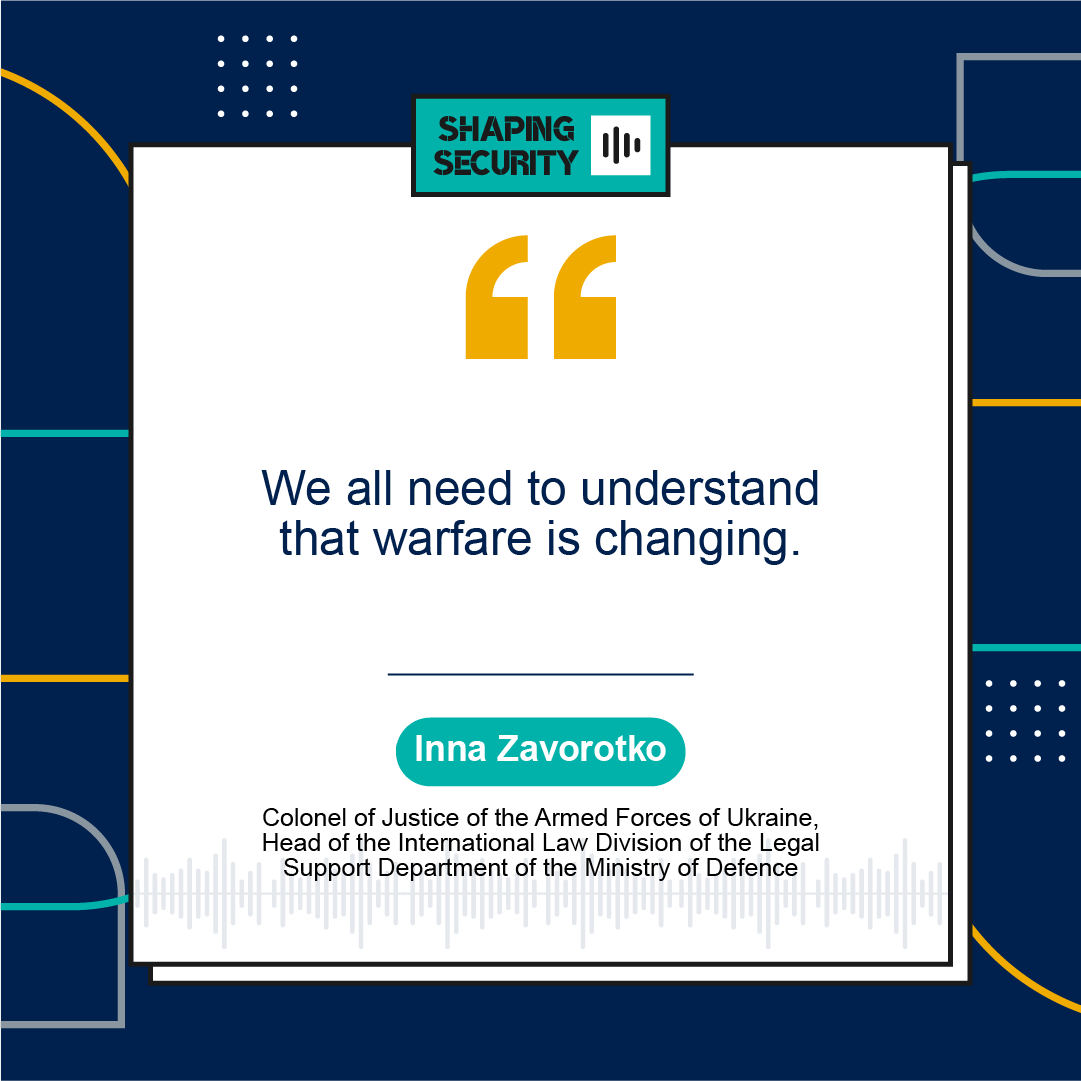
And we all need to understand that warfare is changing. Every two, three months, warfare is changing, which for us and for myself and my team means that we need to be in line with this because you cannot disseminate IHL properly without linking it to what is actually going on on the ground and linking it to the contemporary warfare which is going on. For example, now we have a kill zone.
We have never had it before in other conflicts also. So in kill zone, there is almost none or very few people, right? And it complicates a lot of things.
For example, the obligation to evacuate civilians and sick and wounded combatants, let's say. You cannot physically send people into the kill zone without putting them into the threat to be targeted. So taking into account this very high risk, we shifted evacuation operations from human beings to machines.
So now almost all evacuation operations are conducted with the land drones. And land drone can evacuate whom is needed to be evacuated from the kill zone to the place where we have a physical access, more or less safe physical access to the person. And that will be the point where we will bring human beings to continue the evacuation.
Few years ago, we did not have this pattern, but now we have it and we expect that the kill zone will be wider and wider. Again, for us from IHL perspective, it means that we need to have new means of warfare, including, let's say, land drones, which will be able to go to longer distance to evacuate civilians, wounded and sick combatants or the combat and so on and so forth. So you see how much the contemporary warfare is related to IHL and to the way how you disseminate IHL.
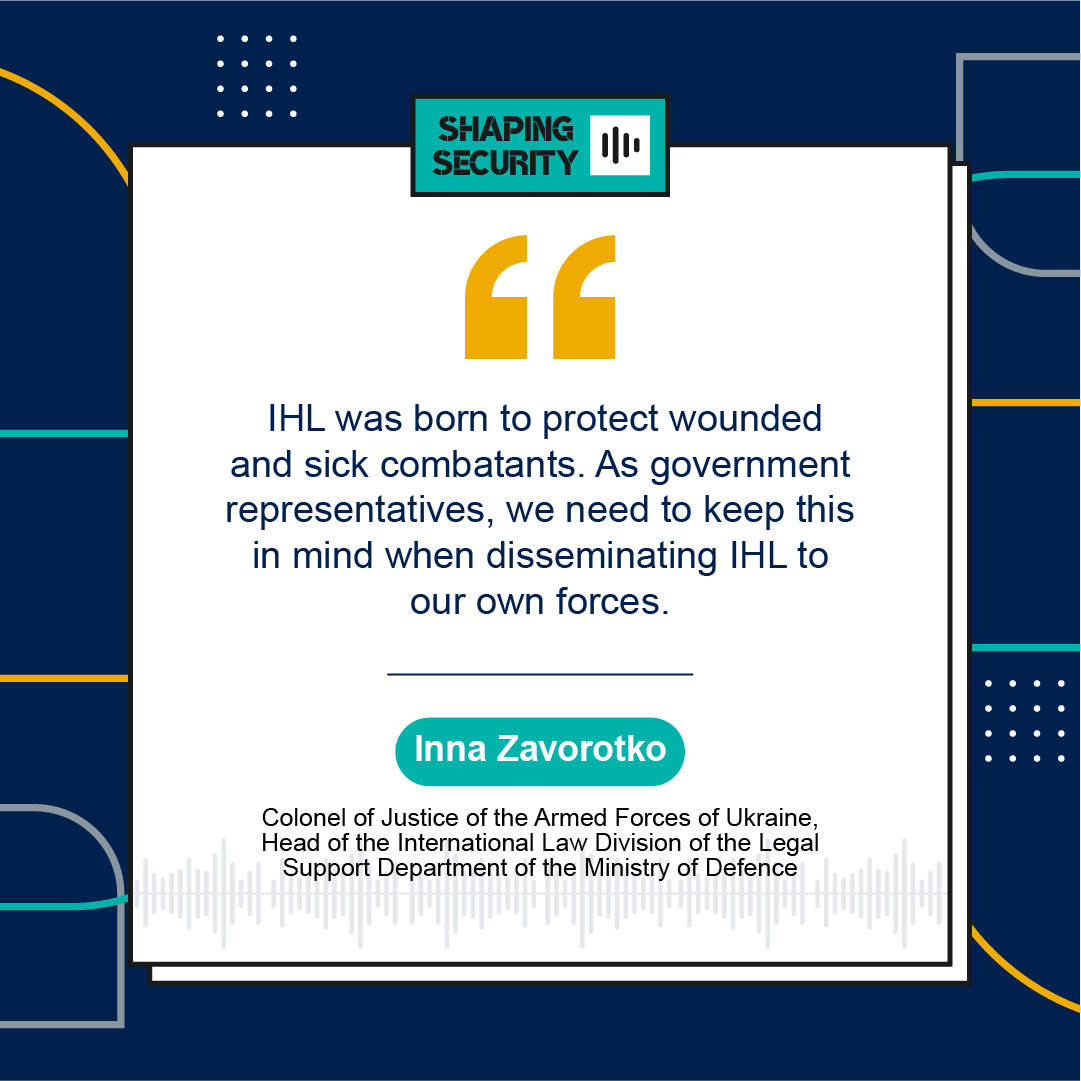
And for myself, for Ministry of Defence and my team more broadly, it is super important to disseminate IHL from the practical perspective and I would say even pragmatic perspective. And I always say that IHL was born firstly to protect wounded and sick combatants. So we all need to keep that in mind as representatives of the government when we disseminate IHL for our own forces.
So we try to be as much practical as possible, to provide recent practical examples and to make our own soldiers to believe in IHL, even despite our enemy does not care about international law.
Maritie Gaidon
Thank you so much, Inna Zavorotko, for your precious insight. I think these examples are really making a huge difference to understand what is really behind this topic of IHL implementation, what is at stake, and I'm sure it will really help our listener to better understand like what you mentioned at the beginning, like this power of soft instruments and what it means in reality, what it can really change. So thank you again very much.
Inna Zavorotko
It's definitely my pleasure and I'm very glad to disseminate Ukrainian experience. And please remember that we remain open for further cooperation from DCAF side, but also those who are going to listen to this podcast. Please reach out to us if you need any information related to IHL implementation or dissemination, or if you have any ideas how we can improve that.
Maritie Gaidon
Thank you. And I will for sure put the link of the report in the description and on our website, so people will be able to reach it. It's in English and in Ukrainian.
Inna Zavorotko
Yeah, right. It's in English, in Ukrainian and in French as well.
Maritie Gaidon
Now let's move on to the second part of the show, which will feature a brief overview of two resources. As usual, you can find more resources on the episode page at dcaf.ch. Okay, the first resource is a video by the International Committee of the Red Cross, which explains the minimum standards set out in IHL. There are four of them.
Number one, the distinction between combatants and civilians. Number two, defining who can be targeted. Number three, the principle of proportionality and precaution.
And number four, how to treat detainees and prisoners of war. Each standard is explained in simple terms. It's an excellent reminder of the fundamentals of the laws of armed conflict.
DCAF provides several free resources on IHL and its legal and practical implementation. Today, I would like to introduce a guide entitled Parameters of effective military training in IHL. It covers different types of military personal training, the most effective methods to implement, and provides examples of the relevance of IHL in the military profession.
What I especially like is that at the end, there is a short list of 10 recommendations. That's all for today. If you enjoyed the show, please share it with a friend.
It helps us spread the word about the podcast and visit dcaf.ch for more resources. Thank you for listening to Shaping Security, the podcast where we put security governance at the heart of the conversation and update you on today's security challenges. If you enjoyed the podcast and would like to support us, please share it with a friend or leave us a review on your preferred podcast platform.
You can find out more about DCAF on our website and our social media channels. We also have a monthly newsletter that shares our latest resources. Don't miss the next episode of Shaping Security.
Recommended resources:
Close

Download this quote and share it on your preferred social media network.