How can the international community hold private military and security companies accountable?
 Share on Facebook
 Share on Linkedin
 Share on Twitter
Gone are the days when private military and security companies (PMSCs) only offered physical security and guarding services.
PMSCs now provide humanitarian aid distribution, border management and detention services, law enforcement, maritime security, and cyber services. Whether acting on behalf of public or private clients, they are increasingly deployed to sensitive areas such as extractive sites and conflict zones.
As PMSCs expand the scope of their activities, so does the risk of their involvement in international crimes and other violations of international law. And where oversight is limited, this exposes vulnerable populations to human rights abuses and other harms.
From Mozambique to Ukraine, abuses committed by PMSCs are well documented. Yet victims face significant barriers when seeking justice, exposing the limitations of rules and frameworks governing their activities.
As the private military and security industry continues to rapidly grow, there is an urgent need to increase oversight and improve accountability.
AN INTERNATIONAL INSTRUMENT FOR HOLDING PMSCS ACCOUNTABLE
PMSCs can play a valuable role as security providers. But to make a positive contribution, they must be held to a high standard, anchored within a framework of good security sector governance, rule of law, and respect for human rights.
Predominantly, two international instruments regulate PMSC activities: the Montreux Document and the International Code of Conduct for Private Security Providers. Both played a crucial role in establishing international standards for the effective governance of PMSCs in the late 2000s.
Yet, persistent gaps in human rights protection and accountability for abuses underscore the need for a comprehensive, up-to-date and human rights centred framework.
To address these gaps, the UN Human Rights Council has established an open-ended intergovernmental working group. Since 2017, Member States have been negotiating the text of an international legal instrument on the regulation, monitoring and oversight of PMSC activities.
The goal is to provide a single UN level Instrument that will unify the regulatory landscape, raise global governance standards, and durably address the adverse impact of PMSC activities on human rights.
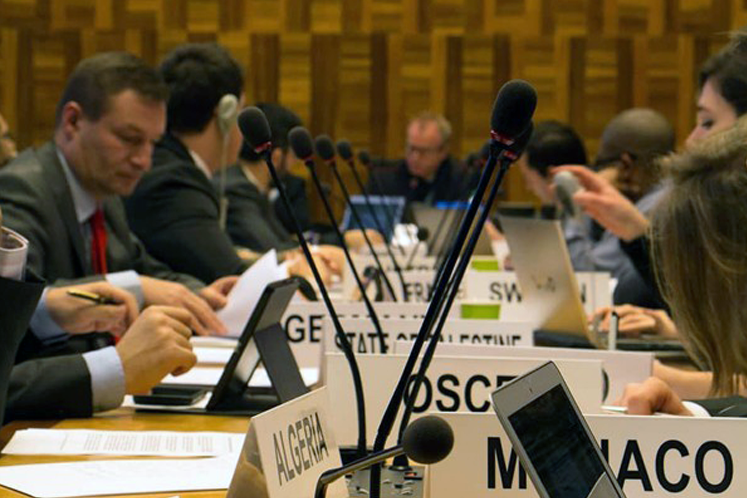
Montreux Document Forum event at the United Nations in Geneva. Photo: DCAF.
ADVANCING ON ACCOUNTABILITY AND JUSTICE: WAYS FORWARD
Cases of litigation against PMSCs remain all too rare due to unclear jurisdictions, loopholes in domestic legal systems, and weak judicial institutions. The UN’s new Instrument must provide a stronger framework for accountability and justice.
One way is to clarify grounds for extraterritorial jurisdiction. Extraterritoriality is especially important for PMSC-related crimes committed in states with inadequate legal and judicial systems. It allows domestic courts to investigate and prosecute persons accused of having committed a crime under international law even if the crime was committed abroad by a foreign national.
Defining different modes of criminal responsibility – including individual, superior, corporate, and state responsibility – is equally important to ensuring that no level of complicity in international crimes is left unaddressed.
Finally, a victim-centred approach is key to deliver meaningful accountability and justice. The Instrument should contain strong provisions on victims’ rights, especially access to effective remedies and reparations for PMSC-related abuses. The UN Guiding Principles on Business and Human Rights and its “Protect, Respect and Remedy” framework are important references in that regard. Useful guidance on corporate level measures can also be found in the Montreux Document and the International Code of Conduct.
Future progress will depend on the Instrument’s ability to build on and cohere around existing frameworks rather than starting anew.
BALANCING NATIONAL SOVEREIGNTY WITH INTERNATIONAL OBLIGATIONS
During the UN Working Group’s last session in April 2026, Member States voiced a number of concerns.
States worried that some of the propositions were incompatible with their existing international obligations or domestic legal frameworks. Others were concerned the Instrument could impose an unnecessary regulatory burden on the activities of PMSCs lawfully operating in their countries.
These legitimate concerns highlight the importance of elaborating a clear, actionable and future proof UN framework which clarifies states’ international legal obligations while bringing added value to the existing regulatory landscape.
To ensure present and future accountability, the scope of the Instrument should accurately reflect reality on the ground: as the PMSC industry rapidly evolves, regulatory grey zones are constantly emerging due to the porosity – and sometimes sheer opacity – of many services, operational contexts and contractual arrangements.
The response must also strike a balance between national sovereignty and international obligations. Although there are obligations that states cannot opt out of, the new UN framework should provide states with the flexibility to determine how best to implement measures domestically.
For example, while providing amnesty for war crimes is incompatible with states' obligations under the Geneva Conventions and customary international law, the Instrument should make it clear that domestic courts otherwise retain prosecutorial discretion.
No matter what path is taken, the Instrument's success should ultimately be measured by its ability to help close the current impunity gap for PMSC crimes.
---------------
This article draws from insights provided during consultations with experts from civil society and academia, as well as from the official positions of Member States during the last session of the UN Working Group on 27-30 April 2026.