Beyond chaos: Haiti‘s need for a national conversation on governance
 Share on Facebook
 Share on Linkedin
 Share on Twitter
When Haiti enters international discourse, it is almost invariably framed by extreme insecurity: gangs controlling 85% of Port-au-Prince, prisons overrun, vigilante justice burning people alive and prosecutors taking up arms, blurring every line between law enforcement and lawlessness. It is a place that seems to warrant immediate action, not talk.
The problem is that action – be it external interventions coming and going or local leadership paralyzed by vested interests – have yielded little so far. The result is profound frustration—among internationals trying to help, national authorities pushing against the impossible, and a population angry at the lack of tangible security in their daily lives.
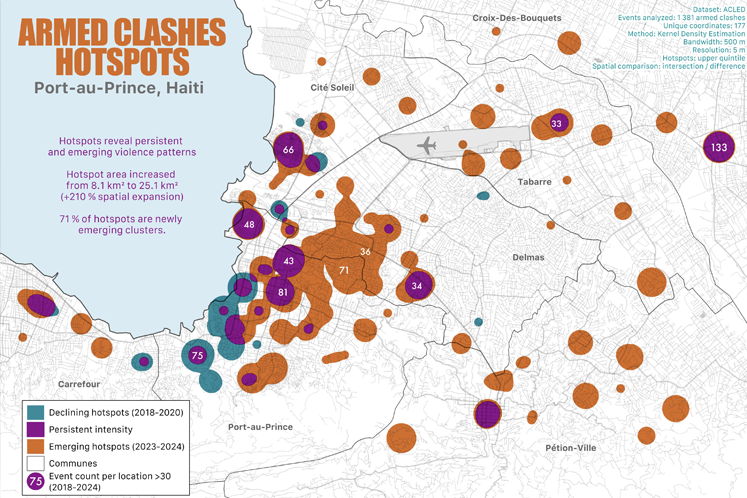
The dynamic of armed clashes in 2018-2024 clearly shows expansion of violence in Haiti.
Map: Sebastian Silva, developed with data from Armed Conflict Location & Event Data
Project (ACLED); www.acleddata.com, access date: 10/05/2025.
Against this backdrop, Switzerland, joined by France and Germany, asked DCAF to examine security sector governance in Haiti and advise on how to improve security-related support provided by international actors.
DEMAND FOR HAITIAN SOLUTIONS
When we began listening to diverse actors, the demand for Haitian solutions rang loud and clear. But this raises a difficult question: which Haiti, and which Haitians, get to define these solutions?
Traditional elites, many complicit in nurturing gangs for political or economic gain, suffer a crippling legitimacy deficit. State institutions are weak. The call for “Haitian solutions,” therefore, must mean something deeper—but this is not yet understood by all those involved.
International actors, frustrated by the lack of progress, often hide behind the concept of local ownership, claiming they are simply responding to what national interlocutors ask for. But those interlocutors are consumed by political infighting and have little incentive to coordinate strategic assistance. They ask for what extends their personal and clique leadership by a few more months or even weeks.
Internationals are not naïve—they know this. But exhausted from pushing for more, they settle for small steps, treating limited "train and equip" activities as positive drops that might one day fill the glass. But will they?
There is another layer. Many national stakeholders lack direct experience with functional, inclusive security institutions. They have never seen a police force that truly protects or armed forces that support democratic governance of the state without own political aspirations.
Expecting them to articulate strategic, future-focused demands—rather than just fighting today’s battles—may be overly optimistic. However, simply giving them what they ask will not lead to significant reforms.
MOVING BEYOND FIREFIGHTING
To get to the core of the problem, we need deeper reflection. Moving beyond firefighting requires a vision for the future—and that cannot come from one person or institution alone. Our consultations suggest this is not yet widely understood by those who should precisely be leading these processes.
What struck us most was the contrast between the exclusion of civil society and the depth of its insights. One youth leader, eager to bring young people into political conversations, admitted that all his friends are in gangs or have direct contacts with them.
“It is the only way to survive,” he said. With that understanding, he is unlikely to support simplistic, force-based solutions that have proven ineffective in the long run. An experienced women’s rights activist voiced her own frustration:
Civil society organizations are hitting a wall. We advocate and propose but get no response from the authorities.
Key media and academic figures have echoed this lamenting that spaces for multi-stakeholder dialogue have all but disappeared. Universities are closed due to insecurity. Media lack resources for thoughtful platforms, while international support focuses almost exclusively on state actors, despite little progress, with little attention given to media or civil society.
A high-level official consulted for the mentioned assessment confirmed this dynamic. When we suggested a joint event bringing together international partners, state officials, and civil society to discuss preliminary findings, he was genuinely confused. “That is not how decisions are made here,” he said. Precisely. And that is why so many decisions fail—they are unilateral and lack buy-in from those who know the ground realities.
NEED FOR FORWARD-LOOKING SECURITY THINKING
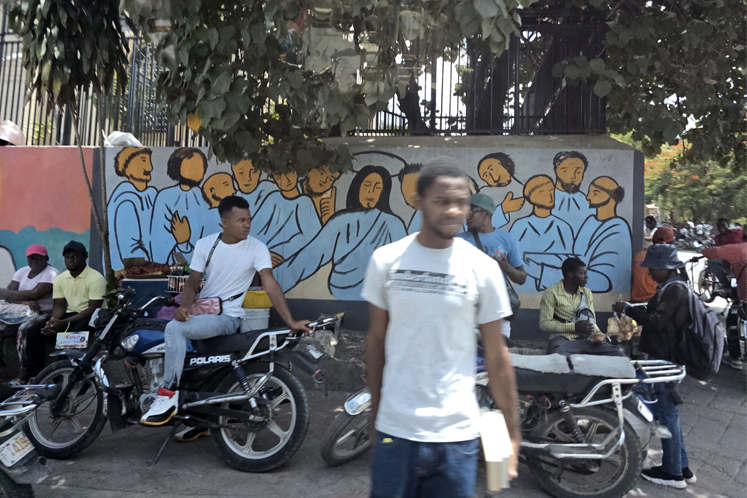
Photo: DCAF, Zoryana Verbych
In a context of deep frustration, dialogue is as much about the process as the results. When violence is the universal currency for gangs, state agents, and vigilantes alike, the knee-jerk reaction is more violence. This will not address the root causes. The starting point must be a fundamental national conversation—or multiple conversations—with forward-looking security thinking.
This means reflecting on the prevention of youth recruitment into armed groups, given that over 50% of gang members are estimated to be minors. It means discussing the role of police and armed forces, whose limited history of coexistence has led to confusion and overlapping mandates.
Could compulsory civic or military service offer a path for youth with few employment opportunities? What can be done now to prevent the seven departments still under government control from sliding into chaos? How can civic education in schools lay the groundwork for a future less prone to corruption?
These are questions that cannot be answered by the usual few.
The path forward is arduous, but it must begin with building a shared understanding of what governance means and how it should shape the future from the ground up. DCAF’s experiences elsewhere—from community conversations around security in the Sahel to dialogue processes in Libya and Yemen or building constructive relationship between police and media in Latin America—show that even in complex environments, inclusion and real national ownership can lead to meaningful changes.
National pride, visible through demands for Haitian solutions, is a precious resource. Where political elites and state institutions lack legitimacy, and armed actors are pervasive, the common ground must be found elsewhere. Haiti’s strong identity and resilience can serve as a convening power, bringing very different actors around the same table.
As one youth leader told us, “Life will eventually resume its course.” But it is today that we contribute to shaping its direction—building upon those brave voices who still dream of a better future.