Advancing WPS and gender perspectives in International Humanitarian Law
Despite recognition of the importance of gender perspectives in conflict and humanitarian response, there remains a significant gap between states’ normative commitments to Women, Peace and Security (WPS) and their practical application in military doctrine and operations governed by International Humanitarian Law (IHL).
Over 2025-2026, this project will create spaces for military legal and gender advisors, scholars, policymakers, gender experts and practitioners to collectively examine the integration of WPS and gender perspectives in IHL.
This project is supported by the Government of Liechtenstein.
Workstreams
This project’s cornerstone is the creation of a Community of Practice that brings together military legal and gender advisors, scholars, policymakers, gender experts and practitioners.
The Community of Practice meets through the project’s Expert Roundtables and through virtual meetings. Members share emergent state practice, consider new and emerging challenges, and build professional collaboration. These exchanges will contribute to developing a compendium of successful approaches for the implementation of WPS commitments in IHL aspects of military operations, and model texts for potential incorporation in military manuals and doctrine.
Are you a military legal advisor interested in joining the IHL Community of Practice for WPS? Please get in touch.
Find out more in the project factsheet: Advancing WPS and Gender Perspectives in IHL:Moving from Analysis to Implementation.
The project’s thematic expert roundtables examine specific issues pertinent to WPS, gender and IHL. They enable Community of Practice participants to engage with key global experts, military and academic, and share their own country’s practices.
On 22 May 2025, DCAF and the Permanent Mission of Liechtenstein to the UN convened an expert roundtable on “Integrating WPS and Gender Perspectives in Civilian Harm Mitigation (CHM) Frameworks”. Participants discussed practical tools, institutional guidance and context-sensitive strategies to integrate gender perspectives into CHM planning and response. The report of the roundtable is : Integrating Women, Peace and Security and gender perspectives in civilian harm mitigation frameworks.
On 3 December 2025, DCAF and the ICRC co-hosted an expert roundtable to discuss “How are militaries implementing IHL obligations to prevent and respond to sexual violence in armed conflict?” Participants outlined the importance of continuing to bridge the gap between "why" (doctrine) and "how" (training and operational planning) to prevent sexual violence.
On 9 March 2026, DCAF, the Permanent Mission of Canada to the UN and the Canadian Red Cross hosted an expert roundtable on “Operationalising IHL in AI-enabled and Autonomous Military Systems”. Participants explored how gender analysis and the WPS agenda can strengthen responsible, lawful use of military AI. The report of the roundtable is: Operationalising IHL in AI-enabled and autonomous military systems: gender and WPS as enablers of lawful use.
In partnership with the ICRC, the development and publication of a Compendium of successful approaches in integrating WPS commitments and gender perspective in IHL aspects of military operations, with model texts for military manuals and/or doctrine.
Find out more in the project-dedicated factsheet: 'Advancing WPS and Gender Perspectives in IHL:Moving from Analysis to Implementation'.
On 21 May 2025, DCAF convened the side event “Where Protection of Civilians and Women, Peace and Security Meet” as part of the UN Protection of Civilians Week. The event was co-organised with the Permanent Mission to the United Nations of Liechtenstein, and co-sponsored by the Permanent Missions of Australia, Canada, Jamaica, the Philippines and South Africa, as well as the UN Department of Peacekeeping Operations, CIVIC, IPI, PAX and the Stimson Centre.
The event brought together nearly 100 participants, including diplomats and other state officials, military officers and legal, humanitarian and protection practitioners from within the UN system, regional organisations and civil society. It aimed to:
- Highlight the legal obligations under IHL for gender-responsive protection;
- Explore the gendered dimensions of civilian harm; and
- Share operational lessons and best practices for mainstreaming WPS principles into PoC policies and operations.
The report of the event is: Where protection of civilians and women, peace and security meet
Discussions in the project’s thematic expert roundtables are developed through partnered research and further consultation with the Community of Practice into a series of practical Policy Briefs.
These outline the IHL dimensions of the issue, challenges and good practices, written for a military and practitioner audience.
Read the policy briefs:
- Improving civilian protection by incorporating gender into civilian harm mitigation tools and processes
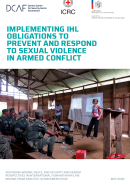
- Implementing IHL obligations to prevent and respond to sexual violence in armed conflict
Key Resources


Contacts
Megan Bastick, Gender and Security Fellow (m.bastick@dcaf.ch)